
Archives
-

SOCIAL WORK IN TIMES OF (RE)CONFIGURATIONS: foundations, training and resistance in confronting the expressions of the social question.
Vol. 35 No. Fluxo contínuo (2026)PRESENTATION OF THE 2026 EDITION (CONTINUOUS FLOW)
It is with great satisfaction that the journal Serviço Social & Realidade (SS&R), linked to the Graduate Program in Social Work of the Faculty of Humanities and Social Sciences at UNESP – São Paulo State University "Júlio de Mesquita Filho", presents its thematic edition for 2026:
SOCIAL WORK IN TIMES OF (RE)CONFIGURATIONS: foundations, training and resistance in confronting the expressions of the social question.
The choice of this theme stems from the understanding that Brazilian Social Work, built on solid historical and theoretical-methodological foundations, currently faces profound transformations in the world of work, in public policies, and in the advance of conservative societal projects on a global scale. The ongoing "(re)configurations" – ranging from productive restructuring and the financialization of capital to the reorganization of right-wing forces worldwide – impose new challenges on professional practice, academic training, and the ethical-political principles that guide the profession.
In this scenario, the debate on the foundations of Social Work cannot be restricted to the past; it is imperative to update it in light of the contemporary metamorphoses of the social question. Likewise, professional training must respond to the new demands of the world of work and the requirements of a critical-transformative practice, without losing sight of the inseparability between theory and practice. Finally, resistance – as an ethical, political, and pedagogical stance – becomes a central element in confronting the multiple expressions of the social question, particularly in a context of neoliberal offensive and the dismantling of rights.
This edition does not close in on a single object of analysis but opens a large thematic umbrella, welcoming contributions that articulate contemporary dynamics with the foundational pillars of the profession. It is hoped, thereby, to foster a plural and updated debate on the role of Social Work in the uncompromising defense of human rights and in the construction of a fairer and more democratic society.
Thematic axes of interest (non-exhaustive):
- Historical and theoretical-methodological foundations – critical revisitations of the Brazilian Social Work tradition, dialogues with critical social theory, updating the debate on the social question in contemporary capitalism.
- Professional training – curriculum, internship, pedagogical practices, challenges of teaching-service-community integration, internationalization of training, impacts of distance education and new technologies.
- Work and professional practice – reconfigurations of the world of work, precarization, outsourcing, working conditions of social workers, moral harassment, worker health.
- Public policies and social security – effects of dismantling, counter-reforms, financialization, judicialization, social participation, social control.
- Resistance and social movements – strategies of collective organization, struggle for rights, confrontation with reactionary conservatism, interprofessional and intersectoral alliances.
- Ethnic-racial, gender and generational issues – intersectionalities, structural racism, gender violence, aging, affirmative policies.
- International and comparative perspectives – Latin American and other contextual experiences, South-South dialogues, migrations, exile, human rights from a global perspective.
Call for submissions
As a continuous flow journal, Serviço Social & Realidade receives submissions throughout the year. Works must be original and can be submitted in the following formats:
- Scientific articles
- Theoretical essays
- Reports of professional experience
- Critical reviews
Contributions are accepted in Portuguese, English, Spanish, French and Italian, expanding international dialogue in the field of Social Work.
All submitted texts are evaluated through the double blind review system, ensuring editorial impartiality, transparent technical criteria, and academic excellence.
Technical data:
- eISSN: 2176‑0896 (Online)
- ISSN: 1413‑4233 (Print)
We invite the Social Work community and related fields to participate in this edition, strengthening the dialogue between foundations, training and resistance. Welcome!
-

DOSSIER: 10 years after the Inter-American Convention on the Protection of the Human Rights of Older Persons: Standardised and/or Implemented?
Vol. 34 No. 2 (2025)This thematic dossier consolidates the reflections and debates from the V International Congress on Active Ageing (2025). It aims to assess, a decade after the Inter-American Convention, whether the human rights of older persons have been effectively standardised into norms and implemented. It seeks to ground and instrumentalise public policy interventions, strengthening the commitment to a dignified old age for the working class.
This publication is the result of an international congress held at UNESP, which brought together academics, professionals, and students to discuss ageing in a context of widening social inequalities, the advance of neoconservatism, and a neoliberal offensive against social rights. The dossier aligns with the critical perspective of Social Work, understanding ageing as a social and historical phenomenon, not merely a biological one.
The reader will find a collection of articles reflecting the main trends and critical concerns in the field of ageing studies, organised around the following axes:
-
Analyses of the commodification of care, the precarisation of public policies, and the overload on female caregivers.
-
Discussions articulating class, race, gender, and generation to explain inequalities in ageing.
-
Investigations into obstacles in accessing Long-Term Care Institutions (ILPIs), mental health services, social security, education, and social assistance.
-
Advocacy for legal-social literacy and education as tools for guaranteeing rights and autonomy.
-
Analyses contrasting the realities of ageing in Brazil, Mozambique, Spain, and Cuba.
Through 11 articles synthesising research from national and international institutions, this dossier constitutes a tool for resistance and struggle, reinforcing the commitment to guaranteeing the rights and dignity of the elderly population, particularly the working class. The work invites critical reading and the appropriation of its content to ground qualified professional interventions and strengthen the fight for a truly dignified old age for all.
-
-

The inseparability between theory and practice in Social Work: weaving connections
Vol. 34 No. Fluxo contínuo (2025)Social Work & Reality Journal (SS&R) – 2025 Edition
It is with great pleasure that Social Work & Reality (SS&R), affiliated with the Graduate Program in Social Work at São Paulo State University "Júlio de Mesquita Filho" (UNESP), presents its 2025 thematic edition: "The Inseparability of Theory and Practice in Social Work: Weaving Connections."
This edition brings together a collection of articles reflecting Social Work's commitment to critically connecting theoretical knowledge with transformative action, offering valuable contributions to academic, professional, and scientific communities.
Published on a continuous flow basis, SS&R stands out for disseminating original scientific works addressing the multiple expressions of social issues. Maintained by the Department and Graduate Program in Social Work at the Faculty of Human and Social Sciences (UNESP), our journal seeks to amplify diverse voices and perspectives, welcoming researchers, professionals, students (undergraduate and graduate), and all those interested in the field – whether from Brazil or abroad, affiliated with academia or not.
Call for Submissions:
As a continuous publication, we continue to accept original works in multiple formats – scientific articles, theoretical essays, professional experience reports, and critical reviews. We value linguistic diversity and welcome submissions in English, Spanish, Italian, and French, aiming to expand international dialogue in the field of Social Work.
All submitted manuscripts undergo our rigorous double-blind peer review process, ensuring academic quality and complete editorial impartiality. This mechanism guarantees that each work is evaluated solely based on its scientific merit and contribution to the field.
Technical Information:
- eISSN: 2176-0896 (Online)
- ISSN: 1413-4233 (Print)
We invite the Social Work community and related fields to join this collective endeavor, strengthening the dialogue between theory, practice, and contemporary challenges.
Welcome aboard!
-
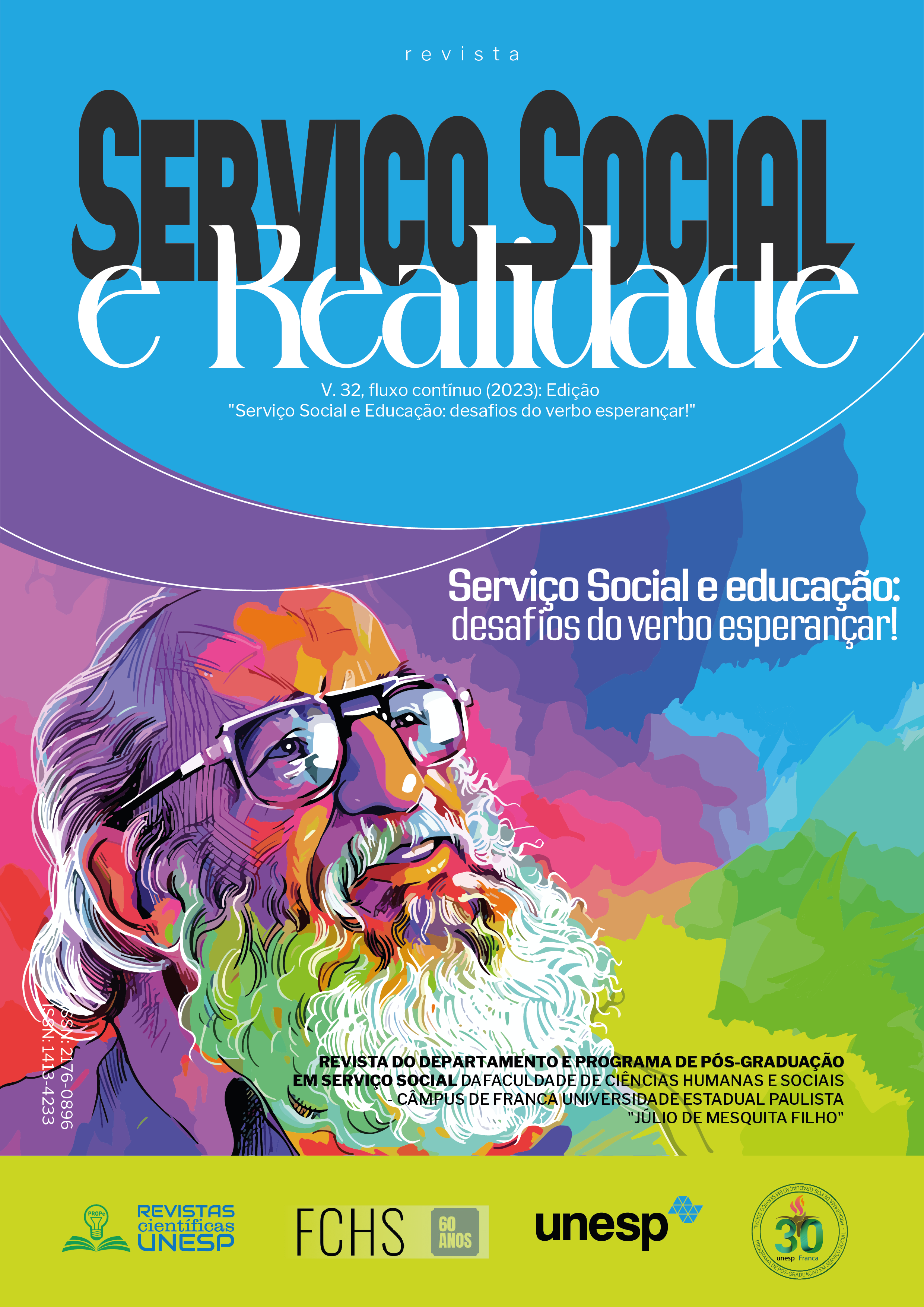
Edition "Social Service and Education: challenges of the verb hope!"
Vol. 32 No. Fluxo contínuo (2023) -
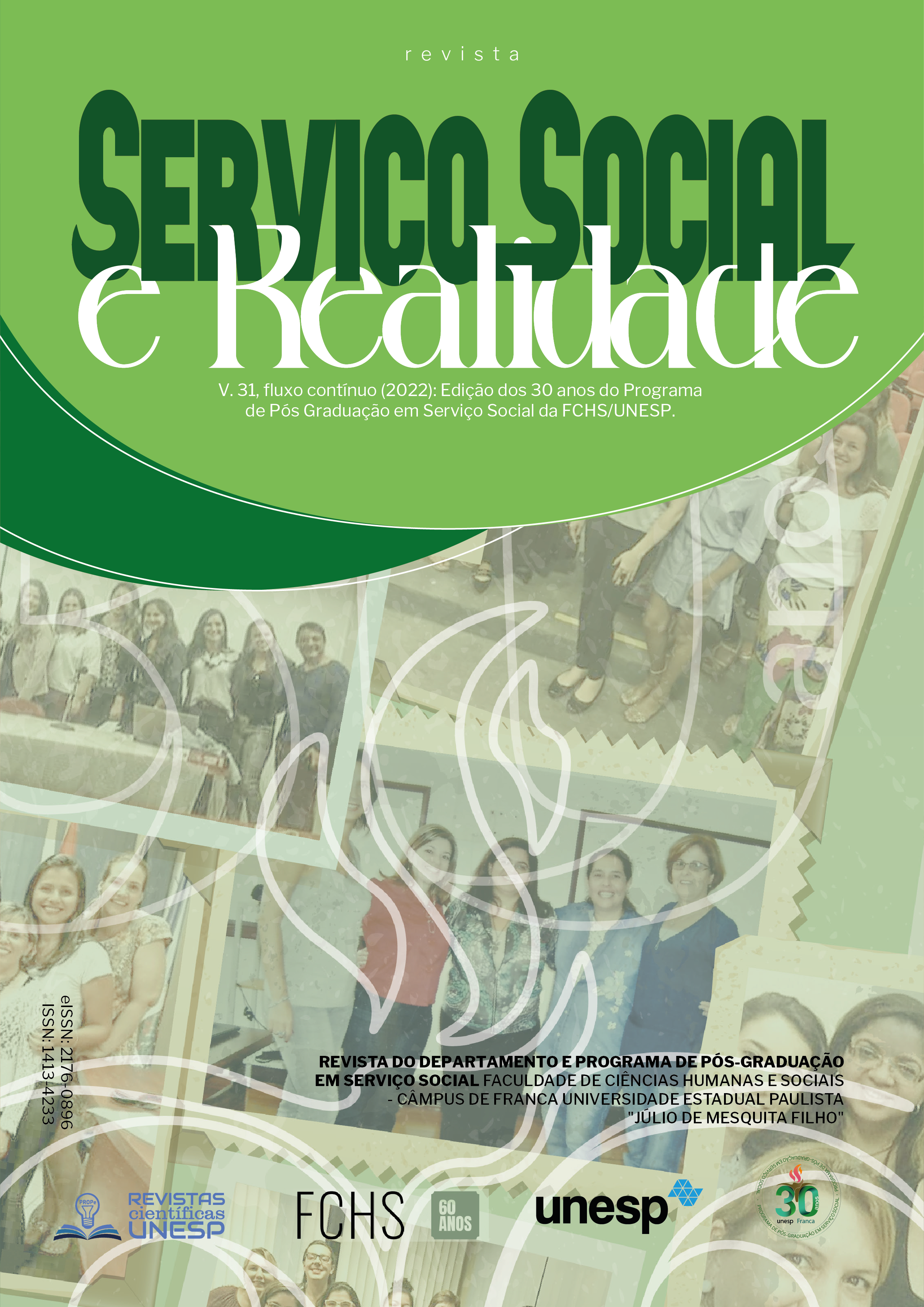
Edition: 30 years of the Postgraduate Program in Social Work
Vol. 31 No. Fluxo contínuo (2022)O ano de 2022 é muito especial para comunidade acadêmica do Serviço Social unespiano, pois além de comemorar 30 anos do Programa de Pós-Graduação em Serviço Social, também representa uma nova perspectiva de organização da Revista Serviço Social & Realidade, em seu volume de número 31 passa a ser organizado como um periódico de fluxo contínuo.
A novidade na Revista Serviço Social & Realidade acontece em um momento especial para nossa comunidade, ano em que o PPGSS comemora seus 30 anos de criação (1991) e o Curso de graduação em Serviço Social comemora 45 anos (1977) de criação. Ao longo da história, a UNESP no campus de Franca formou centenas de bacharéis, mestres e doutores em Serviço Social sendo reconhecida em âmbito nacional e internacional pela qualidade da formação ofertada para comunidade.
A partir do volume 31, os artigos passam a ser publicados logo após ter sido avaliado, aprovado e diagramado, não precisando esperar que a revista lance uma edição para, só então, ser publicizado.
A principal característica e novidade do modelo de edição em fluxo é a agilidade na publicação de artigos. O sistema de submissão e avaliação dos artigos permanece o mesmo; a diferença está na forma como os artigos são disponibilizados para os leitores, pois, uma vez que o artigo tenha sido aprovado, este é trabalhado e publicado. No geral, no modelo de fluxo contínuo não há necessidade de aguardar uma edição para que o artigo seja disponibilizado.
1-25 of 35
Next